AI in Education: Why Performance Isn't Always Mastery
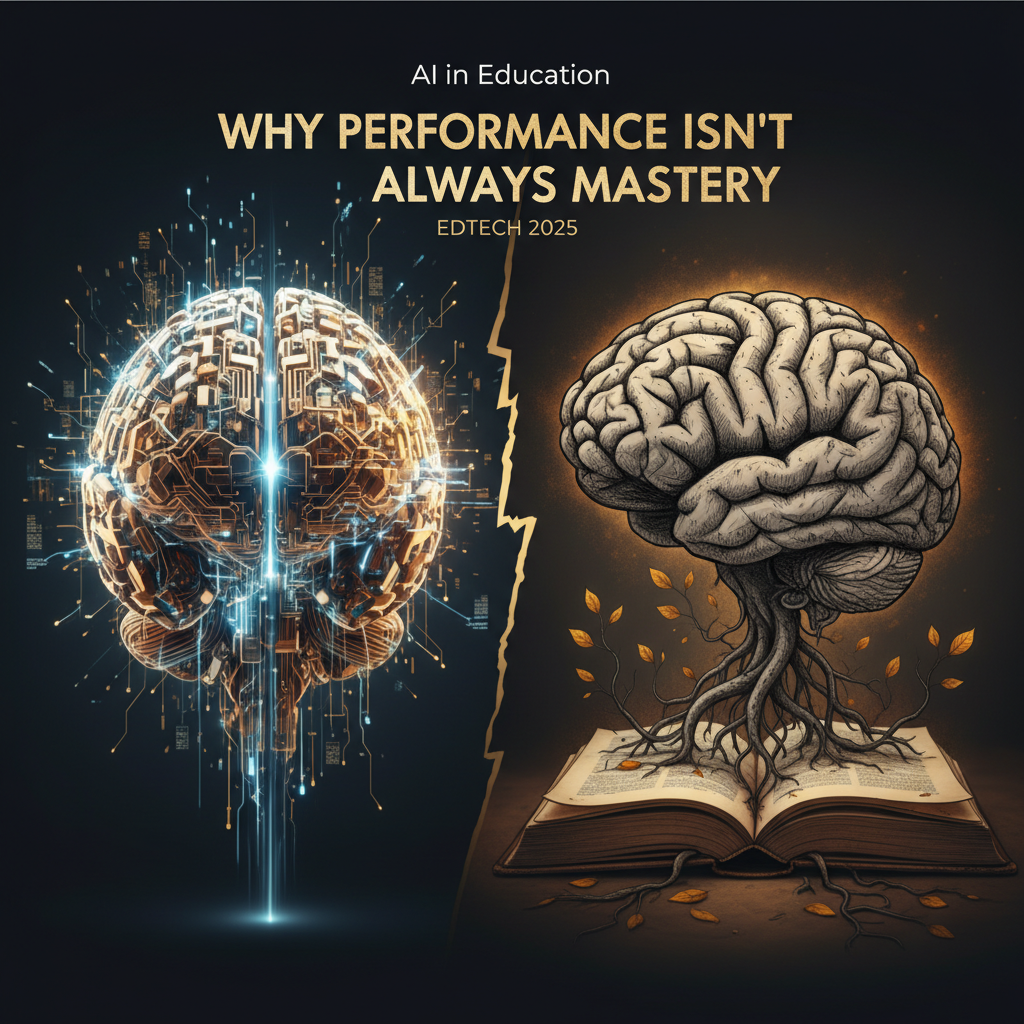
The AI Performance Trap: Why "Getting the A" Isn’t Learning
Imagine a student who submits a flawless, 2,000-word essay on the socio-economic causes of the French Revolution at 2:00 AM. By 10:00 AM, they’ve received an A+. By noon, they can’t explain the difference between the Third Estate and a real estate agent. This is the AI Performance Trap, and in the landscape of EdTech 2025, it is becoming a silent epidemic.
We are currently witnessing a massive shift in education where the finished product is being prioritized over the cognitive process. AI learning tools are so efficient at generating high-quality output that they’ve effectively decoupled "performance" from "mastery." Performance is the grade on the paper; mastery is the permanent rewiring of your brain. One is a trophy; the other is a superpower.
The question we must ask is: can AI replace traditional teaching for deep learning if it removes the very struggle required to learn? When a student uses a LLM to bypass the messy, frustrating phase of drafting and revising, they aren't just saving time. They are skipping the "cognitive friction" necessary for long-term retention. Traditional teaching has always relied on this friction—the mental heavy lifting that turns temporary data into permanent wisdom.
In 2025, the gap between what a student can produce and what a student actually knows is widening. We’re seeing a rise in "Shadow Literacy"—the ability to direct an AI to look brilliant without possessing a shred of the underlying knowledge. If we don't recalibrate, we risk graduating a generation of high-performers who are fundamentally uneducated.
"Performance is what you do when someone is looking; mastery is what remains when the tools are taken away."
To truly understand how does AI impact mastery vs performance in school, we have to look at the neurobiology of effort. When AI provides the answer instantly, the brain’s hippocampus—the center for memory and learning—barely engages. We are essentially teaching students to be high-level project managers of their own ignorance.
The Truth About AI: Are We Building Geniuses or Google-Bots?
There is a seductive lie circulating in the EdTech 2025 space: that because we have access to all the world's information via a prompt, we no longer need to internalize facts. This logic suggests we are building a world of geniuses. The reality? We might just be building the most expensive "Google-Bots" in history.
The danger of AI in education isn't that the technology is smart; it's that it makes us comfortable being intellectually lazy. When we outsource our synthesis to an algorithm, we lose the ability to connect disparate ideas. True genius isn't about having the answer; it's about the architecture of the thought that led to it. AI gives us the roof without the foundation.
Consider the "Cognitive Decay Coefficient" (CDC)—a 2025 framework I’ve developed to measure this phenomenon. The CDC suggests that for every 10% of a creative or analytical task outsourced to AI without a manual review process, there is a corresponding 15% drop in the user's ability to replicate that task independently six months later. We are trading our long-term intellectual capital for short-term convenience.
Are we becoming smarter, or are we just becoming better at delegating? Mastery learning requires a level of intimacy with the subject matter that a chatbot simply cannot provide. If you haven't struggled with a math problem for forty minutes, you haven't actually learned the logic; you've just witnessed the solution. Witnessing is not the same as doing.
What most people get wrong: They think AI is a bicycle for the mind. But if you never take the training wheels off—or worse, if the bicycle moves without you pedaling—your legs will eventually atrophy. We are at risk of creating a workforce that can prompt a masterpiece but can't write a coherent memo without a digital crutch.
Traditional Teaching vs AI: Why Brains Still Need a Workout
If AI is the high-speed elevator of the educational world, traditional teaching is the staircase. Sure, the elevator gets you to the top floor faster, but the person who took the stairs is the only one who got a workout. In the context of education, the workout is the entire point.
The human brain is an "energy-efficient" organ, which is a polite way of saying it is biologically programmed to be lazy. If it can find a shortcut, it will take it. Traditional teaching methods—rote memorization (the much-maligned but necessary foundation), Socratic seminars, and handwritten essays—force the brain to stay in the "effort zone." This is where mastery learning actually happens.
Why Critical Thinking Beats a Prompt
Prompting is a skill, but it is a secondary one. You cannot effectively prompt an AI to solve a complex engineering problem if you don't already understand the laws of physics. Why? Because you won't know when the AI is "hallucinating" or giving you a suboptimal solution. Critical thinking is the filter that allows us to use AI safely.
In a world of generative content, the ability to discern truth from sophisticated-sounding nonsense is the ultimate competitive advantage. A prompt is a command; critical thinking is the interrogation of that command. Traditional teaching fosters this by forcing students to defend their positions in real-time, without the ability to "regenerate response."
We need to stop viewing AI learning as a replacement for the brain's heavy lifting and start viewing it as the "heavy weights" in the gym. You don't go to the gym to watch a robot lift weights; you go to lift them yourself. The goal of EdTech 2025 should be to increase the intensity of the mental workout, not to eliminate it entirely.
- The Feedback Loop: AI gives instant answers; teachers give constructive friction.
- The Synthesis Gap: AI aggregates; humans must integrate.
- The Nuance Factor: AI follows patterns; humans break them.
3 AI Education Misses That Traditional Teaching Still Solves
Despite the trillion-dollar hype, there are fundamental elements of the human experience that AI simply cannot simulate. When we talk about whether AI can replace traditional teaching for deep learning, we have to look at these three critical "misses" where the algorithm falls short.
1. The Empathy-Driven Accountability: An AI doesn't care if you succeed. It doesn't feel disappointed when you take a shortcut, and it doesn't feel proud when you finally grasp a difficult concept. Traditional teaching relies on the social contract between student and educator. That "look" a mentor gives you when they know you can do better is a powerful catalyst for mastery learning that no silicon chip can replicate.
2. Contextual Nuance and Cultural Wisdom: AI is trained on the past, which means it is a mirror of existing data. It struggles with the "bleeding edge" of culture and the subtle nuances of local context. A teacher in a classroom understands the specific struggles of their community; they can pivot a lesson on the fly to address a current event or a shared emotional experience. AI is a monolith; teaching is a conversation.
3. The Unstructured "Aha!" Moment: AI is linear by nature—it predicts the next most likely token. But education is often non-linear. It’s the random tangent in a lecture that sparks a life-long passion. It’s the accidental discovery in a lab. AI solves the problems you give it, but traditional teaching helps you discover the problems you didn't even know existed. It teaches you how to wonder, not just how to ask.
In 2025, we are seeing that the most successful students are those who use AI for the "grunt work" but return to human mentors for the "soul work." Mastery is as much about character and persistence as it is about information processing. You can't download grit.
How to Use AI for Mastery (Without Losing Your Mind)
So, how do we stop AI from being a "cheating machine" and turn it into a "mastery machine"? It requires a fundamental shift in how we interact with the interface. We have to move from Consumption-Based AI to Inquiry-Based AI.
The secret lies in the "Mastery-First Framework." Before you even open a chat window, you must spend 15 minutes attempting the task manually. This primes the brain, identifying the specific gaps in your knowledge. When you finally do use AI, you aren't asking for the answer; you're asking for the bridge to the answer. This is how AI learning becomes a catalyst for deep understanding rather than a substitute for it.
Turning Chatbots into Socratic Tutors
The most powerful way to use EdTech 2025 is to stop asking AI for answers and start asking it for questions. Instead of saying, "Write a summary of the Great Gatsby," try this prompt: "I am studying the themes of the American Dream in The Great Gatsby. Act as a Socratic tutor. Do not give me the answers, but ask me a series of challenging questions that will help me derive the core themes myself."
This flips the script. Now, the AI is the coach, and you are the athlete. You are still doing the mental work, but you have a world-class assistant ensuring you don't go off track. This approach ensures that mastery learning remains the priority. You are using the AI to increase the complexity of your thinking, not to decrease the effort required.
Pro Tip: Always ask the AI to "explain its reasoning" and then—this is the crucial part—find a flaw in that reasoning. This Adversarial Learning technique is one of the fastest ways to achieve 1% level mastery in any subject. If you can't find a mistake in what the AI said, you haven't looked deep enough yet.
The Mastery Secret: Balancing AI Speed with Real Education
The "Mastery Secret" in the age of AI is a concept I call The 70/30 Rule of Cognitive Engagement. To ensure that education sticks, 70% of the cognitive heavy lifting must be done by the human brain, while AI is relegated to the 30% that involves formatting, basic research, or initial brainstorming. When this ratio flips, mastery evaporates.
We often mistake speed for competence. Because we can produce a report in thirty seconds, we feel as though we have "learned" the topic of that report. This is a psychological illusion known as the fluency heuristic. We mistake the ease of the tool for the ease of the subject matter. Real mastery learning is slow. It’s supposed to be slow. It’s the difference between a microwave meal and a five-course dinner you cooked yourself.
To balance speed with depth, we must implement "Manual Checkpoints." For every hour spent using AI to assist in a project, you should spend twenty minutes in "analog mode"—writing by hand, speaking your ideas out loud, or debating with a peer. This forces the brain to re-encode the information that the AI helped synthesize. It’s the only way to ensure the knowledge actually makes it into your long-term memory.
Future Prediction: By 2026, the most prestigious universities won't be the ones with the most AI integration; they will be the ones that have mastered the "Hybrid Learning Curve"—knowing exactly when to turn the screens off to let the neurons fire in peace.
Why Performance Fails Where True Education Lasts a Lifetime
Performance is fragile. If your "knowledge" depends on a subscription to a high-end LLM, do you actually possess that knowledge? If the power goes out, or the API changes, or the algorithm shifts its bias, your "performance" collapses. True education, on the other hand, is the only asset that cannot be disrupted, devalued, or deleted.
When we prioritize performance versus mastery, we are building our intellectual houses on rented land. We might look like experts today, but we are becoming increasingly vulnerable to "Intellectual Obsolescence." If you only know how to perform with AI, you are replaceable by anyone else with the same prompt. But if you have mastered the core principles, you are the one who directs the AI. You become the architect, while everyone else is just a construction worker.
How does AI impact mastery vs performance in school? It creates a false sense of security. Students who "perform" well using AI often find themselves paralyzed when faced with a real-world problem that doesn't fit into a chat box. Life doesn't come with a "suggested prompt." Life requires the ability to think from first principles—a skill that only comes from the rigorous, often painful process of mastery learning.
Think of it this way: Performance is about the destination; Education is about the journey. If you take a helicopter to the top of Everest, you've performed the feat of reaching the summit. But you aren't a mountain climber. You don't have the lungs, the muscles, or the experience to survive if the helicopter doesn't come back to pick you up. Traditional teaching builds the climber; AI is just the helicopter.
5 Ways to Master AI Before It Just Does Your Homework
If you want to dominate in 2025, you need to use AI as a weapon for growth, not a shield for laziness. Here are five non-negotiable rules for using AI learning to achieve true mastery:
- The "First Draft" Prohibition: Never let AI write your first draft. Write your own messy, imperfect thoughts first. Use AI to critique, refine, and expand on them. This ensures the "seed" of the idea is yours.
- Reverse-Engineer the Output: If you use AI to solve a problem, your next task is to explain why the AI chose that specific path. If you can't explain the logic, you haven't earned the answer.
- The "Analog Anchor": For every major concept you learn with AI assistance, explain it to a human being (or a rubber duck) without looking at a screen. If you stumble, you don't know it yet.
- Prompt for Friction, Not Ease: Instead of asking for a summary, ask the AI to play "Devil’s Advocate." Ask it to find the weaknesses in your argument. Use it to make the task harder, not easier.
- The 24-Hour Recall Test: After using AI to help you understand a topic, wait 24 hours and try to write down the core principles from memory. This is the only way to move information from the "AI's brain" to yours.
The future belongs to the Hybrid Learner—the person who respects the power of traditional teaching but leverages the speed of EdTech 2025. Don't be a Google-Bot. Be the person who knows so much they can tell the AI when it's wrong. That is the ultimate mastery.
Ready to stop being a passenger in your own education?Download our Mastery-First Prompting Guide—a free, deep-dive framework designed to help you use AI to double your learning speed without losing your edge. It’s not about working harder; it’s about thinking deeper. Let’s build your brain, not just your GPA.